Wednesday, October 2, 2013

Friday, 16 August: Second Day in London

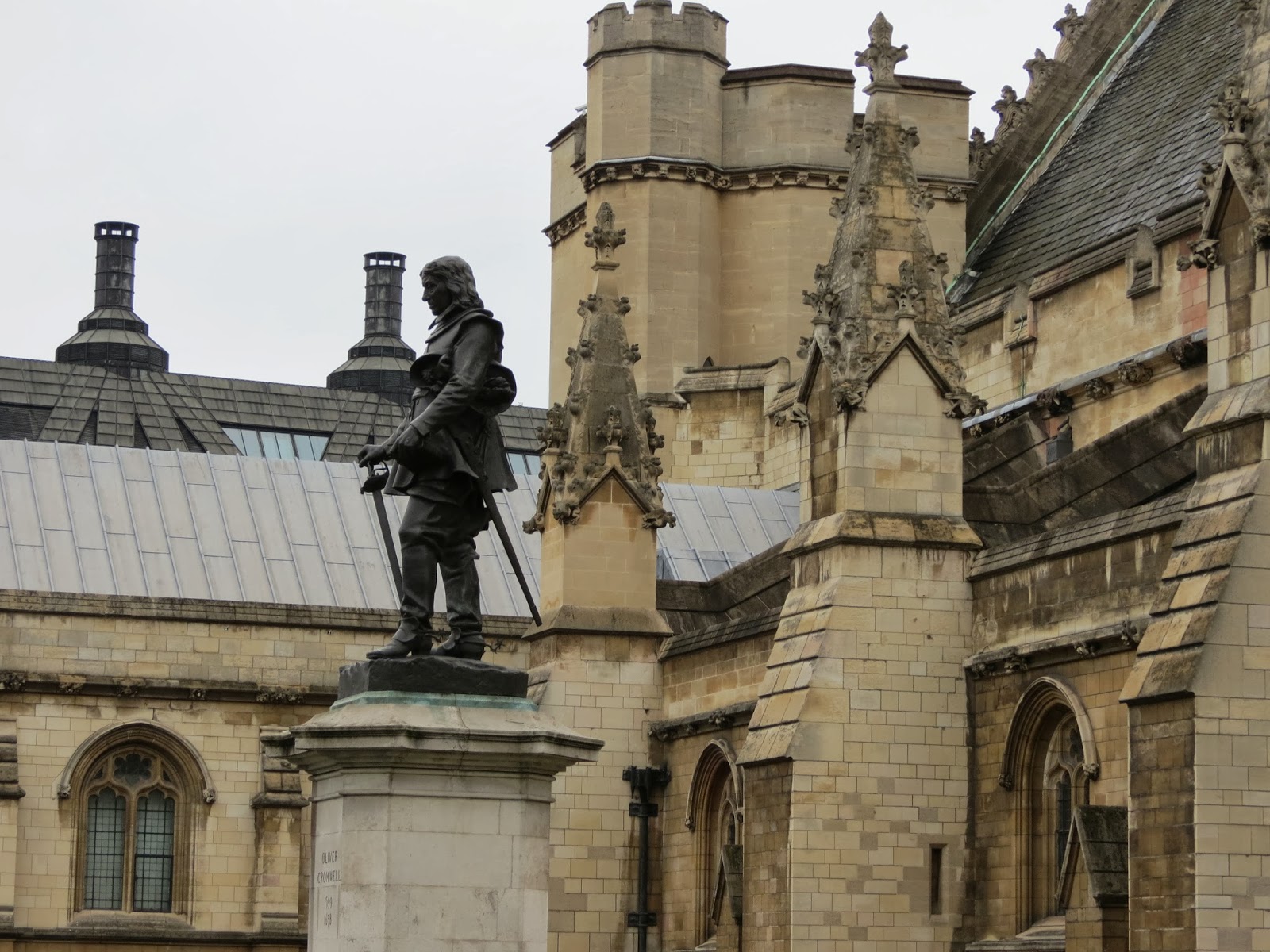
In which we were treated to a private tour of some of the Tower of London, particularly the British Crown Jewels exhibit (sorry, no pictures of those--for security reasons, the guards permit no photography--but trust me, they're impressive); a visit to the Palace of Westminster and the Houses of Parliament with a tour of the House of Lords and House of Commons (again, no photos of the interior except for Westminster Hall, the oldest existing part of the palace). After a get-your-own lunch in Covent Garden, we visited the Wesley Chapel and House, located across the street from Bunhill Fields Cemetery, a Nonconformist (i.e., non-Anglican) burial site that has the tombs of John Bunyan, Daniel Defoe, John Owen, William Blake, and Susanna Wesley, among other notables. Sadly, due to a technical glitch I could not take photographs in the cemetery. The day ended with a dinner cruise on the Thames; I have representative shots of views of the city from the river (Greenwich; Tower Bridge; the Shard; the dome of St. Paul's Cathedral). The lovely lady contemplating her place setting is my wife, Shirley.


Special Edition: Sutton Hoo Artifacts

By popular demand...

Just as an introduction, the Sutton Hoo ship burial find occurred in the 1950s (I think), purportedly the grave of an early seventh-century Anglo-Saxon king; some scholars believe he was Raedwald of the East Angles, who had the status of bretwalda (high king, if the office ever really existed) toward the end of his reign. From an archeological perspective, the find was a veritable treasure-trove. At the time of our visit to the British Museum, the permanent exhibit of Anglo-Saxon artifacts was undergoing renovation, but many of the more important pieces were still on display. The following is a small sample of the collection.


Tuesday, October 1, 2013

Thursday, 15 August: First Day in London

After getting to the hotel (the Royal Horseguards) from the airport, we rode the London Eye, then took the Underground to Smithfield's Market, where many Protestants were martyred by the regime of Mary Tudor, briefly visited Saint Bartholomew the Greater Church (one of the oldest medieval churches in London; it survived the Great Fire of 1666), and then hopped over to the British Museum before returning to the hotel.


A) The lobby of the Royal Horseguards Hotel; B) the London Eye; C) St. James's Park, with Buckingham Palace in the middle distance; D) the view from the Eye eastward up the Thames toward the City of London; E) Trafalgar Square with Nelson's Column, and the National Gallery in the right background; F) the Protestant Martyrs' Memorial at Smithfield; G) the facade of Saint Bartholomew the Greater (the interior is a great example of Norman architecture, but very dark and hard to photograph); H) artifacts from the Sutton Hoo Anglo-Saxon burial site (the helmet is very famous); I) Assyrian bulls; J) a rather large red granite pharaoh's head; K) one pediment of the Parthenon (Elgin Marbles); L) the other pediment of the Parthenon; M) the entrance facade of the British Museum.

Monday, September 30, 2013

2013 UK Trip Photos


This is very much experimental--I'm trying to figure out how to do all this for the first time. Taken from the top, we have the Houses of Parliament viewed from the London Eye on the opposite bank of the River Thames; the Rosetta Stone in the British Museum; the Tower of London, with Traitor's Gate visible at the waterfront; Durham Cathedral; the choir of York Minster; and the esplanade of Edinburgh Castle. If this works, I'll try to post some more, arranged by topic.

Monday, February 13, 2012

Demonstration of the Atheist's Folly, Part Six

Charnock next observes that the being that does not understand itself thoroughly and is not capable of ordering itself cannot make itself. In order to make something properly one has to comprehend it. More than three centuries after Charnock wrote man still lacks comprehensive knowledge of himself, of his own nature. It is certain that this is not just lost knowledge--that at one point in the distant past some supremely wise man had such knowledge but somehow failed to pass it on.

He also observes, somewhat parenthetically, that the knowledge of ourselves we gain from Scripture about our nature, while not accessibly through the exercise of reason, is not contrary to reason. Here he would be talking chiefly about man's sinfulness and fall from original righteousness.

Charnock then explores a hypothetical: Say for the sake of argument that the first man did in fact make himself. If this is the case, why did he make himself with limits? Why is man not decked out in power and excellences? It is a certainty that man desires to be much more than he is; why not indulge all his desires at the outset? In fact, man's limitations testify to his contingency.

Sunday, February 12, 2012

Demonstration of the Atheist's Folly, Part Five

Wow, I really have been remiss. A combination of a bad cold and many other demands on my time. I'll try to do better.

In the next section of his argument, Charnock maintains that no creature can create itself. In the specific case of man, he quotes Psalm 100:3: "Know that the Lord himself is God; it is he who has made us and not we ourselves." To delve into the matter deeper, he observes that every created thing began to be (i.e., had a beginning, as already demonstrated) and once was not. If something is not, does not exist, it is no thing or nothing. At one time, I was not--depending on precisely when you want to time my beginning, we can say at least that prior to 1958 I did not exist and therefore was nothing. That may be existentially uncomfortable, but there you have it. And when I was nothing--when I did not exist--I could do nothing. That which is nothing cannot act. It cannot do. Nothing can act before it is. And therefore no creature can create itself, for to create is to act and the creature cannot be and not be in the same time and in the same relationship. Rationality 101, folks--the law of noncontradiction.

Tomorrow I hope to move to the next section of this argument in which Charnock considers not just the impossibility of creatures self-creating but the necessary processes by which things are created.

Wednesday, February 1, 2012

Demonstration of the Atheist's Folly, Part Four

In the first place, simply that creatures are testifies to their Creator. "All things that are demonstrate something from whence they are." A statue testifies to the existence of a sculptor; a garden testifies to the existence of a gardener; a book testifies to the existence of a writer.

Furthermore, all creatures had a beginning. There was a time when they were not. The world is not eternal or from eternity, so someone or something had to bring it into existence. This "cause" of creation must itself be in being before it created--"that which is not cannot act."

Charnock elaborates two additional arguments here. He first observes that time itself cannot be infinite (the kalam argument familiar to the Christian apologist) else now could not have yet arrived. Therefore the world is not eternal. He specifically argues from the finitude of past heavenly revolutions, meaning that the planets have accomplished a finite number of orbits around the sun, and the moon a finite number of orbits around the earth--there cannot be an endless stretch backwards in time. Secondly, generations of living things cannot be infinite or from eternity because they develop or mature and thus require time. And because in the current state of things we experience decay and death, an eternal generation of creatures would necessitate an eternity of corruption; in this, Charnock was likely anticipating the concept of entropy.